


The lower back is called the lower back - from the area where the ribs end to the coccyx (the lowest protruding vertebra).Most of the time, when a person has “back pain,” we are talking about the lower back.And if 20 years ago, pain in the lower back bothered mainly the elderly, now even quite young patients turn to specialists for help with their backs.
Why does the lower back suffer so often?The fact is that the center of gravity of the human body is located precisely at the height of the lumbar spine and bears almost the entire load when walking.This is one of the disadvantages of upright walking - vertebrates that move on 4 limbs do not suffer from these diseases.
Causes of low back pain – what you need to know
Statistical studies tell us the following about the frequency of causal factors for low back pain:
- 91% of calls are problems with the spine and the muscular structure of the back.
- 5% of complaints are related to diseases of the urinary system.
- 4% - pathologies of other organs (reproductive system, gastrointestinal tract).
Types of low back pain
Often, back problems arise unexpectedly - like a bolt from the blue.This sharp pain in the lower back is called “lumbago” and previously it was possible to hear the term “lumbago”.The name itself speaks of the sharp and intense nature of the sensations.During an attack of low back pain, any movement only intensifies the torment, and the patient involuntarily finds himself in a constrained position, freezing in one position.Lumbago lasts for several minutes and then disappears.
If the pain is prolonged and painful in nature, we are talking about lumbodynia.These are low-intensity but constant painful sensations in the lower back, which intensify during physical activity or during hypothermia.
And there is a condition in which there is no back pain, but the person feels stiffness and discomfort.In this case, additional diagnostics from specialists are also required.Depending on how low back pain manifests itself, approaches to treating it vary.
Low back pain as a symptom of illness?
Back pain itself can signal very different pathological conditions and often understanding the true cause is not so easy.
For example, there is something called displaced pain.It denotes a situation in which the right, left or lower back hurts - and the person thinks that the cause of their torment is in the spine.However, after research, it was discovered that one of the internal organs (kidneys, intestines or organs of the reproductive system) is to blame.The human body is very complex and confusing.Let's look at some possible causes of discomfort in the lower back.
Musculoskeletal disorders that cause low back pain
The connection between spinal diseases and low back pain is direct and unequivocal.It was previously mentioned that spinal pathologies are the most common cause of back pain and represent more than 90% of all consultations.
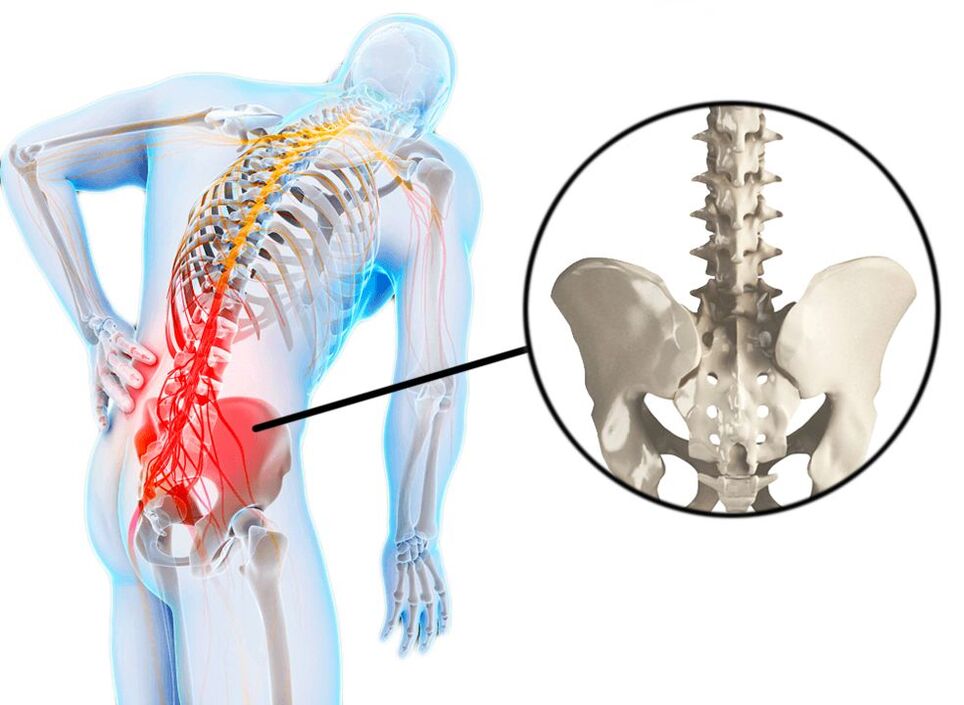
Intervertebral disc protrusions and hernias are rightfully in first place in terms of prevalence.With these destructive pathologies, the intervertebral disc initially moves slightly outward, prolapses (protrusion of the disc), and as the disease progresses, the integrity of the disc is disturbed to such an extent that the inner part (nucleus pulposus) comes out of the surrounding fibrous ring.
Protrusions most often occur due to traumatic damage to the disc or osteochondrosis.
Another painful consequence of osteochondrosis is compression and pinching of the sciatic nerve.The pain is sharp and sharp - low back pain.
As a result of this compression, the nerve can become inflamed.The general name for this disease is radiculitis, and if the inflammation affects the sciatic nerve, it is referred to by the more specific term “sciatica.”The pain in sciatica is concentrated in the lower back and spreads to the buttocks and thigh along the sciatic nerve.
Now about the disease that leads to the development of all of the above - osteochondrosis.Pain in the lower back with osteochondrosis is of a sharp or dull aching nature.With the development of the disease (2nd and 3rd degrees), neurological symptoms appear - numbness, tingling sensation in the lower extremities.In the morning, a person is bothered by a feeling of stiffness.The functioning of the gastrointestinal tract, kidneys and reproductive system is disturbed.
The main goal in treating osteochondrosis is to relieve pain and prevent the destruction of the vertebrae and intervertebral discs.It is important to understand that the sooner treatment is started, the better the prognosis.
Kidney pain, urinary tract and lower back pain
You must have heard.that low back pain is caused by kidney disease.In some cases this is actually true.We recommend seeing a urologist if you are concerned about the following symptoms:
- Frequent painful urination, change in urine color.
- Deterioration of health, indifference to life.
- Hyperthermia is a high temperature.
- Decreased appetite, feeling of nausea.
- Arterial hypertension.
The pain varies.For example, with an exacerbation of chronic pyelonephritis, the pain seems to pull and envelop the lower back, and renal colic is sharp and short-lived.
It is characteristic that pain in renal pathology is concentrated on one side - since one kidney is involved in the inflammatory process.This is how a kidney stone (stone) appears in the kidney or ureter.
Another important diagnostic criterion is that in nephropathies, the intensity of pain does not change with changes in body position.However, as you understand, it is better to leave the right to make an accurate diagnosis to a specialist.
Excessive exercise and lower back pain
Our spine is adapted to physical activity.Therefore, the appearance of back pain after going to the gym should alert you.Typically, pain in the back muscles due to the accumulation of lactic acid disappears within 1 to 2 hours, and if this does not happen, pathology should be suspected.
The cause of back pain after playing sports may be old injuries or hidden problems with the intervertebral discs - for example, disc protrusion.In this case, the elimination of physical exercise will not lead to a cure, but will only hide the course of a destructive disease of the spine.
Additionally, back pain after exercise is characteristic of myofascial syndrome.It does not pose a threat to life, but significantly reduces its quality.
At the same time, physical activity can also contribute to the disappearance of back pain - for example, an overweight patient is more likely to get rid of back pain as a result of weight loss.
Remember that constant and periodic pain in the lower back after physical activity should be a reason to see a doctor.
Hypothermia and low back pain
Prolonged exposure to cold air and wind can cause hypothermia.If the lower back is not protected from harmful environmental factors, an uncomfortable condition such as myositis can occur.This is the name for inflammation of skeletal muscles.The pain is aching in nature and upon palpation (palpation) there is a stiffening of the back muscles.
Features of low back pain in women and the mechanism of its occurrence
It's no secret that women's well-being is closely related to their hormonal levels, which undergo dramatic changes not only throughout their lives, but also every month.Therefore, every month, at a certain phase of the menstrual cycle, women may experience dull pain in the lower back.Unfortunately, this is a variant of the physiological norm.
And during pregnancy, discomfort in the lower back is considered normal - if it goes away after rest.After all, significant hormonal changes occur in a woman's body during this period, the uterus expands - which changes the deflection in the lumbar region and shifts the center of gravity.Furthermore, a pregnant woman's weight naturally increases, which also increases stress on the spine.
If we talk about other causes of pain in the lower back in women, back pain may indicate the approach of menopause.This is due to a decrease in estrogen levels and changes in several other sex hormones.
Therefore, the diagnosis of the causes of low back pain in women must be carried out with special care, so as not to miss important symptoms of serious diseases and not to rule out the pathological causes of low back pain in women.In fact, among these formidable diseases can be cysts, apoplexy or inflammation of the ovary and even cervical tumors.Ignoring and prematurely diagnosing such conditions can lead to infertility and critical complications.
What diseases can cause low back pain?
Symptoms, nature of pain |
Presumptive diagnosis by MRI |
| Lower back pain when coughing, sneezing, bending over. | Protrusion (bulging) of the intervertebral disc of the L1/L2 vertebra (L2/L3, L3/L4, L4/L5) |
| Numbness, tingling not only in the back, but also in the buttocks and lower extremities. | Symmetrical dorsal (posterior) protrusion of the discs of the L1/L2 vertebra (L2/L3, L3/L4, L4/L5) |
| Weakness in leg muscles and worsening of motor reflexes. | Median dorsal (posterior) protrusion of the discs of the vertebrae L1/L2, L2/L3, L3/L4, L4/L5 |
| Sharp, sharp pains;the patient cannot even straighten up during an attack. | Circular protrusions of the vertebrae L1/L2, L2/L3, L3/L4, L4/L5 |
| Staying in the same position for a long time causes intense pain. | Diffuse protrusions of the vertebrae L1/L2, L2/L3, L3/L4, L4/L5 |
| Symptoms may be absent for a long time and are discovered by chance. | Protrusion of the median disc of the vertebrae L1/L2, L2/L3, L3/L4, L4/L5 |
| Sharp, stabbing pain in the lower back - also called "lumbago." | Herniated disc of the vertebrae L1/L2, L2/L3, L3/L4, L4/L5 |
| Pain in the leg that extends below the knee, “pins and needles” sensation in the leg. | Dorsal disc herniation of vertebrae L1/L2, L2/L3, L3/L4, L4/L5 |
| It is often asymptomatic, with patients reporting only mild discomfort. | Schmorl's hernia of vertebrae L1, L2, L3, L4, L5 |
| The functioning of the intestines, bladder and reproductive system is disturbed. | Paramedian disc herniation of vertebrae L1/L2, L2/L3, L3/L4, L4/L5 |
| In the initial stages, the course is asymptomatic.Pain occurs when the tumor spreads beyond the disc. | Hemangiolipoma and hemangioma in the L1 vertebral body (L2, L3, L4, L5) |
| The pain depends on the degree of displacement of the vertebra.If changes occur in the joints, movement disorders will be observed. | Retrolisthesis and antelisthesis of the L1 vertebra (L2, L3, L4, L5) |
| The pain is periodic at first, then becomes constant.Increased by physical activity. | Ventral wedge-shaped deformity of the L1 vertebral body (L2, L3, L4, L5) |
| Aching pain in the lower back, left or right, along the spine.Numbness, “pins and needles” sensation.Muscle tension. | Magnetic resonance imaging, signs of degenerative-dystrophic changes (osteochondrosis) of the lumbar spine |
| Rsharp pain due to exertion or careless movement.Changes in gait, dysfunctions of the genitourinary system. | Osteochondrosis of the lumbar spine, 1st degree (2nd degree, 3rd degree) |
| Pain in the buttocks and legs, discomfort from sitting in a chair for a long time and walking for a long time. | Spondyloarthrosis of the lumbar spine, 1st degree (2nd degree, 3rd degree) |
What to do if you have low back pain?
If your back and lower back pain symptoms do not go away or lessen within 3 days, you should see a doctor.What to do before visiting a doctor?
What can you do for lower back pain yourself?
If the cause of the pain is unknown:
- measure your temperature to detect inflammation in the body.
- determine accompanying symptoms (vomiting, diarrhea or others)
- call a doctor at home or go to the emergency room.
If the cause of the pain is known (bruise, sprain or injury to the lower back):
- take a non-steroidal anti-inflammatory drug (NSAID) - diclofenac, ibuprofen or other.
- Applying cold locally will help reduce swelling and relieve pain.
- Firmly squeeze the lower back with a towel or orthopedic belt to fix the injured area in one position.
- Consult a doctor for a complete diagnosis and determine further treatment tactics.
What not to do for lower back pain
- Under no circumstances should you heat a painful area of your back!Heat will increase blood flow and, if there is inflammation, it will worsen the situation: it will increase pain and lead to the spread of the infectious process.For the same reason, you should avoid going to bathhouses and saunas.
- You won't be able to relieve pain for long if you have persistent, unexplained back problems.Ignoring the root cause can only aggravate the course of the disease and lead to serious complications.
- You cannot try to straighten the vertebrae yourself or massage your back forcefully.Without diagnosis, such actions can cause vertebral displacement and cause unnecessary additional injuries.
Which doctor should I see for lower back pain?
It happens that a person would be happy to look for a specialist, but they don't know which doctor to go to with complaints of low back pain.Let's bring some clarity to this matter.
First of all, you should make an appointment with a general practitioner.He will make a differential diagnosis and determine which doctor you should continue treatment with.It could be:
- Neurologist – for neurological symptoms and involvement of nerves in the process.
- Urologist – if diseases of the urinary system (kidneys) are suspected.
- Gynecologist – for the treatment of diseases of the female reproductive system.
According to indications, a complete blood count (CBC) and general urinalysis (UCA), X-ray examination of the spine (in particular, MRI), ultrasound of the pelvic organs, kidneys and other studies may be prescribed.
It is important to remember that self-medication and other home remedies for lower back pain are a waste of time and money.In addition, by delaying a visit to a specialist, you run the risk of acquiring an advanced form of the disease, thereby dooming yourself to long-term, expensive and often less successful (than in the initial stages) treatment.
How to cure low back pain: basic treatment methods
Naturally, you may have a question: if self-medication is not effective, how to cure low back pain?A competent specialist has many techniques in his arsenal, including conservative and surgical treatment.
Conservative treatment consists of the following points:
- Take anti-inflammatory drugs (NSAIDs) and analgesics orally and locally.
- Physiotherapy (shock wave therapy, acupuncture).
- Kinesiotherapy.
- Therapeutic massage.
- Therapeutic exercise and gymnastics.
Physiotherapeutic procedures and massages should be carried out after the acute phase of the disease, when the pain syndrome has already been alleviated.
Surgical treatment is indicated in advanced cases of spinal diseases, when conservative methods fail to obtain any significant results.However, with timely diagnosis and correctly prescribed treatment, the need for surgical interventions can be delayed or completely avoided.
Lower back pain prevention
As a rule, painful sensations in the back and lower back appear due to a careless attitude towards one's health.After all, a sedentary lifestyle, burdened by sedentary work and forced prolonged stay in the same position, is typical for many of us.Excessive physical activity without preparation (stretching) and lifting weights with incorrect back position are no less harmful.It's no wonder that the majority of the world's population experiences lower back pain.
Doctors' advice to prevent back pain:
- Watch your posture, keep your back straight.
- Avoid awkward postures in the workplace.You can place a small pillow under your lower back to support it.Try it!
- When sitting at the table for a long time, it is recommended to get up from time to time (every hour), preferably doing a joint warm-up, or simply walking.
- It is advisable to sleep on an orthopedic mattress;It is quite hard and, at the same time, elastic.
- Start your day with exercises to strengthen your back and core muscles.
How to lift weights correctly?
If you need to pick up and carry something heavy, do so by bending your knees, not your back.That is, first you need to sit down, pick up the load and then straighten your knees, making your back straight.
Low back pain: what to do?
Now that you've read about the most common causes of lower back pain, know what you need to know and what to do, the question arises - who to turn to?Definitely, when choosing a clinic, preference should be given to a medical center where you can be consistently examined by several specialists.That is, you will not need to go to the other end of the city for additional diagnostics, and a complete and comprehensive treatment plan for back and lower back pain will be drawn up in one place.
The qualifications of doctors and the availability of suitable equipment play an equally important role.After all, lower back pain caused by osteochondrosis and myositis requires different approaches to therapy.